Overview
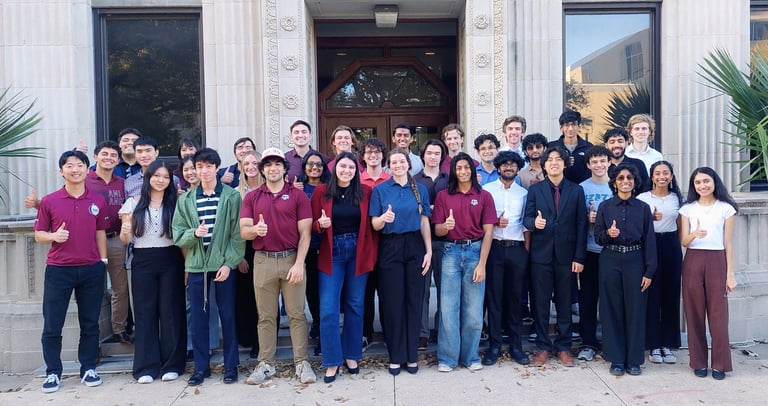
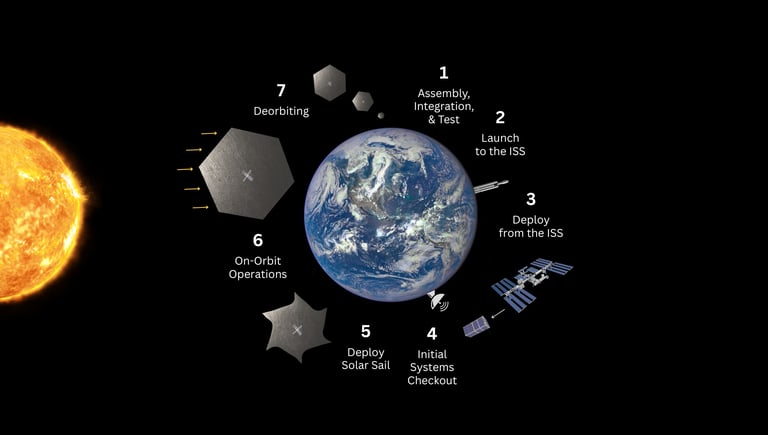
TAMU SSS (SEDS Solar Sail) is an independent project that I founded in September 2024 to launch the first student-led solar sail technology demonstration mission into orbit. Since then, I have served as Project Manager, leading the team to conduct research, expert outreach, mission design, and R&D of a novel sail deployment system using SMAs (shape memory alloys). Our first CubeSat mission, Solaris I, is planned to launch to the ISS by fall 2027 to demonstrate our SMA sail deployer on orbit.
Backstory
It was the evening of November 13, 2023. I was on my way back from Houston after a design team showcase with my friends on Team Vestigo. At that point, I was the Outreach Director for SEDS, and we didn't have any teams yet. So there I was, sitting in the car, trying to think of something cool that we could do. Not another rocket, or a CubeSat, like countless other teams were already doing, but something new. Something truly innovative.
All of a sudden, an idea popped into my brain. We could do a solar sail! So I pulled out my phone and started researching. Could we really do it? Maybe, I decided. But it was a big maybe, so I shelved the idea and went on with my life.
Fast forward to January 19, 2024. I was flying back to Texas (after being stranded in Buffalo for a couple days due to a snowstorm) when I came across this article. It was a fascinating Q&A with a team at UC Berkeley working on small solar sails, but there was one sentence in particular that really caught my eye: "If we do everything right, the cost of the solar sails will be a thousand dollars or less." A thousand dollars!? Now that was something we could work with.
Of course, I knew development costs would be significantly higher than that. And I knew there was still plenty of work to be done before we could really determine if a solar sail project was feasible. However, it was a promising start. So I decided to form a team in September 2024, and we got to work.
The Project
For the first two semesters, we conducted in-depth research and expert outreach to explore different mission concepts and identify the most feasible one for us to pursue. I knew that high-level research projects like this were notoriously difficult to keep on track, so I tried my best to set clear expectations & milestones, keep members accountable, and continuously engage them with the long-term vision of the project.
We still faced our fair share of challenges and lack of participation from members, but nevertheless, I was able to keep the team on schedule and execute our plan successfully. By May 2025, we had selected our mission concept – demonstrating a novel, SMA-based sail deployment system.
Since then, I have been leading the team to conduct research & development of our SMA-based deployment system, as well as mission design for a series of CubeSat missions that we will be launching to demonstrate our deployment technology on orbit. Currently, we are working towards the launch of our Solaris I mission, which is targeted to launch to the ISS by fall 2027. As Project Manager, I also spearhead our systems engineering efforts and ensure that all aspects of our design work are in sync as we work to demonstrate a ground-based prototype of our deployer and complete PDR (Preliminary Design Review) by the end of the spring 2026 semester.